
The Lundy model and what it means for pupil voice in schools
A practical guide to lundy model.
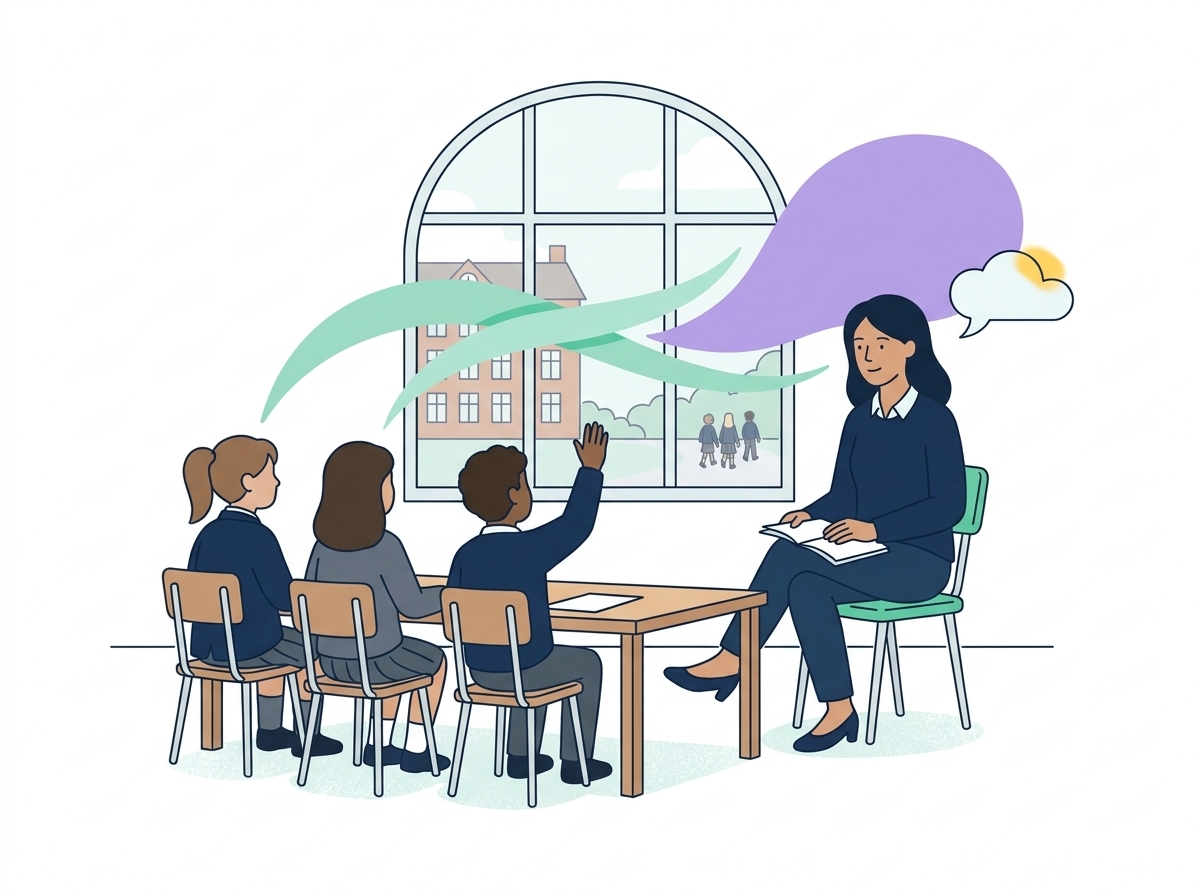
The Lundy model is a four-part way of reading the right of children to have their views heard and given due weight, and it is most useful when a school treats it as a decision routine rather than a listening exercise. Leaders who want to take pupil voice seriously often meet it early, and the practical question is how four ideas become a survey, an owner and a visible response. What follows sets out what the model says, what each element asks of a school or trust, and how perception data can show whether the conditions are in place.
Where the Lundy model comes from and what it says
Professor Laura Lundy of Queen's University Belfast set out the model in a 2007 article in the British Educational Research Journal, "Voice is not enough: conceptualising Article 12 of the UN Convention on the Rights of the Child". Article 12 says a child who can form a view has the right to express it freely in matters affecting them, and to have it given due weight according to age and maturity. Lundy's contribution was to break that single sentence into parts a practitioner can act on. The title carries the argument: inviting views is not enough on its own.
The four elements are straightforward:
- Space: children are given a safe and inclusive opportunity to express a view.
- Voice: children are helped to express that view in a form they can use.
- Audience: the view is listened to by someone with the authority to act on it.
- Influence: the view is acted on as appropriate, and the child is told what happened.
The first two describe what happens before a pupil answers. The last two describe what happens afterwards, and that second half is the part that turns a consultation into participation.
A common misreading treats the model as a framework for running a school council. A council can be one way to create space, but the model applies to any decision that affects children: a change to the lunch queue, a behaviour policy review, the layout of a Year 7 induction, a trust-wide decision on uniform. Seen this way, the test is not whether the school has a pupil voice structure. It is whether, for a given decision, the four conditions held.
That framing also explains why the model travels well into trusts. A trust board making a decision about transition across several academies faces the same four questions, only at larger scale and with more distance between the people asked and the people deciding.
What space and voice ask of a school or trust
Space raises a question that is easy to overlook: who is not in the room? Councils, ambassador groups and focus groups tend to draw pupils who are confident, well attended and comfortable with adults. Pupils who rarely volunteer, who miss a good deal of school, who have SEND or who are new to English may hold the views a leader most needs to hear, and they are the least likely to turn up to a lunchtime meeting. Inclusive space usually means going to pupils rather than waiting for them.
Voice is a separate problem. Lundy's point is that children need support to form and express a view, and that a blank invitation to "tell us what you think" favours those with the most fluent written or spoken language. Structured formats do more of the work here: a statement such as "there is an adult in school I can talk to" with an agree to disagree scale, a multiple-choice question about where pupils spend lunchtime, a rating of how easy it is to find help. Pupil surveys of this kind avoid free text altogether. Pupils answer set questions, and leaders read scores and patterns by group rather than individual comments. That keeps responses comparable and keeps the survey accessible to pupils who find writing a barrier.
An illustration
Suppose a secondary school reviews its pupil council and finds that most members are in Years 7 to 9 and have high attendance. Sixth formers, older pupils with patchy attendance and pupils with SEND are barely represented. The council is working as intended, but it cannot stand in for the whole school.
The school adds a short termly survey for every pupil, delivered in tutor time. It is available with audio read-aloud and in translated versions, so pupils who are new to English can answer in the language they understand best. Participation now covers the whole roll rather than the volunteers. The council stays, and its role shifts: it helps interpret results and test ideas for a response, which suits it better than speaking for everyone.
Space and voice get views into the building. What happens to them next decides whether pupils keep answering.
Why audience and influence are where most schools stall
Most schools and trusts collect views well. Surveys go out, results come back, and a summary reaches the leadership team. The difficulty comes in the second half of the model, where a view has to reach someone who can act and then produce a visible outcome. Audience is not satisfied by a report that sits in a shared folder. It means a named person with the authority to change something has read the result and knows it is theirs.
A practical test can be applied to any single result. Schools that do this well tend to ask three questions of it:
- Is there a named owner?
- Is there a date by which a decision will be made?
- Is there a point at which pupils and staff will hear the outcome?
If one of these is missing, the result is usually collecting dust. The owner is often the weak point. A finding that belongs to "the SLT" belongs to nobody, whereas a finding that belongs to the head of Year 8 or the SENCO has a chance of moving.
Influence also gets misread as agreement. Lundy's wording is that views are acted on "as appropriate", and that leaves room for a considered no. Pupils may ask for later lunch, no uniform or fewer tests. A school cannot grant most of these, and it does not need to. What matters is that the view was weighed and the pupils were told how.
This is why "you said, we did" works better as "you said, we did, and here is what we could not do". A reply such as "you told us the lunch queue is too long; we cannot extend lunch, but we have opened a second serving point and will ask again in the spring" gives pupils a reason to answer next time. Silence teaches them the opposite. Pupils who see nothing happen after a survey tend to respond less carefully the next time, which damages the quality of the data as well as the culture.
How belonging data can show the Lundy conditions are working
The four elements can be mapped to things a survey can measure. Space becomes questions about whether pupils feel they have a chance to say what they think. Voice becomes whether they find it easy to do so. Audience and influence become whether pupils feel their views are asked for, listened to and acted on. Put together, these give leaders a read on whether the conditions exist in practice, rather than on paper.
The value increases when results are broken down. An average across a school can look healthy while one group tells a different story. Comparing year groups, pupils with SEND, Pupil Premium or disadvantaged pupils, and pupils with EAL shows where the conditions hold and where they do not. A school may find that pupils agree they are asked for their views, but that pupils with SEND are much less likely to agree that anything changes as a result. That points to an influence problem for one group, which calls for a different response from a school-wide issue.
A trust-level example
Suppose a trust runs the same belonging survey in all its academies, with identical questions and timing. Year 7 pupils at one academy score much higher on "adults here listen to me" than Year 7 pupils at another. Because the questions and the term are the same, the difference is a real signal rather than an artefact of how each school asked.
The trust does not treat this as a verdict. The education director asks the lower-scoring academy what its audience route looks like. Who reads the results? How do concerns raised by Year 7 reach a decision-maker? Is there a visible response? The answers often show a gap in the route rather than in the adults themselves, and the higher-scoring academy may have a practice worth sharing.
Connecting this to outcomes
Leaders have good reason to treat belonging and experience as indicators connected to attendance, behaviour and attainment, and not as pastoral extras. The Education Endowment Foundation's guidance on improving behaviour and its work on attendance both discuss school climate and relationships as factors worth attention. Specific figures vary by study and age group, so it is better to read the sources directly than rely on a headline number. The practical point is that perception data gives leaders something earlier and more granular than attendance and suspension figures alone.
How the model sits alongside UK policy and inspection expectations
The Lundy model has a long track record in the devolved nations. As of 2026, it is widely used in Scotland, Wales and Northern Ireland, where government and children's commissioner materials have drawn on it to shape guidance on participation. In Northern Ireland it was developed with government support for work on listening to children, and Welsh Government guidance on pupil participation also draws on it. UNICEF UK's Rights Respecting Schools Award is built around the UN Convention on the Rights of the Child, and schools working towards it often meet Lundy's ideas in that context. Details of awards and guidance change, so leaders should check the current published versions before citing them.
For schools in England, the model fits naturally with current policy emphasis. The Every Child Achieving and Thriving white paper, published in February 2026, gives weight to inclusion and to children feeling they belong in school. It is worth reading the exact wording in the document before quoting it in board papers. The link to draw is a practical one: a school that can show how pupils' views shape decisions has evidence of the kind of inclusive culture the policy points towards.
The same applies to inspection conversations. Inspectors and trustees tend to respond well to specifics: a survey, a cohort result, a named owner, a change and a follow-up measure. A leader who can walk through one decision from pupil view to outcome shows more about the school's culture than a file of policies would.
It helps to treat the model as a planning tool that strengthens strategy a school or trust already has. It does not need a separate programme, and it should not become a compliance exercise with its own paperwork. If it sits inside existing cycles, such as termly leadership reviews, trust board reporting and improvement planning, it adds discipline to what leaders already do. The aim is to be able to show, with evidence, that pupils were asked, heard and answered.
A termly routine for putting the model into practice
A routine that works across a single term gives each Lundy element a place. One sequence many trusts and schools use looks like this:
- Run a baseline survey in the first half-term.
- Break results down by cohort: year group, SEND, Pupil Premium and EAL.
- Assign a named owner to each low-scoring group or topic.
- Make a response visible to pupils and staff.
- Repeat the survey at the end of the term or at the start of the next.
Some practical details make this easier to sustain. Surveys of around five to ten minutes tend to achieve better completion, particularly from the pupils whose views are hardest to reach. Sharing headline results with staff before pupils see them gives teachers time to understand the findings and avoids surprises. Reporting back to pupils works well in assemblies or tutor time, using a short summary of what the results showed and what will change.
Several pitfalls come up repeatedly. Over-surveying is the first: asking too often, or asking about too many things, leads to fatigue and weaker data. Reporting only averages is the second, because averages hide the cohorts that most need attention. The third is asking about topics the school cannot change. If a question touches something outside the school's control, such as national exam policy, the survey raises expectations it cannot meet, which damages trust in the whole process.
A cycle that feels light, with clear owners and a visible response, tends to hold up better than an ambitious programme that exhausts the people running it. Consistency from term to term also lets leaders see change over time, which is what makes the data useful for planning.
How Satchel Pulse can help
Perceptions, from Satchel Pulse, runs termly belonging surveys for pupils, staff and families. Results can be compared across academies using identical questions and timing, and broken down by cohort using data from the MIS, such as year group, SEND, Pupil Premium and EAL. That makes audience and influence easier to evidence: a trust can show who saw a result, who owned the response and what changed by the next survey.
A sensible next step this term is to choose one Lundy element, such as audience, and run a baseline survey with a named owner for each result.
Testing the model on one cohort and one decision
The Lundy model is only as strong as its audience and influence stages. Space and voice get views into the open, but pupils judge a school by what happens next: whether someone with authority read the result and whether anyone told them the outcome. A school or trust that can answer those two questions for a single decision has put the model to work.
A good place to begin is small. Pick one cohort, perhaps Year 7 or pupils with SEND, and one decision this term that affects them. Ask them through a structured survey, name the owner, set the date and plan how the answer will reach them. Learn more about our services
Where is your school on the belonging journey?
Take the free belonging self-check. A few quick questions place your school at one of four stages, from exploring to sustaining, and show what to focus on next.
Take the self-check


Related articles




Contact our education team
